SME Sector in Bangladesh: Size, Support, and the Gaps That Startups Can Fill
Bangladesh's CMSME sector covers over 11 million enterprises and roughly 80 to 85 percent of non-agricultural employment, contributing an estimated 25 to 30 percent of GDP. As of March 2026, actual CMSME lending sat at 15.87 percent of total bank loans against a 25.50 percent regulatory target, a gap that's widened rather than closed.
Key Takeaways
Bangladesh Bank's CMSME Master Circular 2025 sets loan ceilings by category and by industry type: manufacturing, service, trading
As of March 2026, actual CMSME lending was 15.87 percent of total loans against a 25.50 percent target, a gap of nearly 10 percentage points
Cottage and micro enterprises make up almost all business entities but hold only about 13 percent of outstanding CMSME loan value
Women entrepreneurs received 7.28 percent of CMSME lending in Q1 2026, against a 15 percent regulatory target
BanglaBiz 2.0, launched in February 2026, compresses five core registration approvals into a three-day process
One term needs sorting out first. Bangladesh's central bank and government documents mostly write CMSME, short for cottage, micro, small, and medium enterprise. This article uses SME as the general term, but switches to CMSME whenever it's quoting Bangladesh Bank's financing data directly, since that's the framework the numbers come from.
With that settled: Bangladesh Bank's own reporting counts more than 11 million CMSMEs nationwide, providing an estimated 80 to 85 percent of non-agricultural employment. For anyone weighing business registration in Bangladesh as a first step, that scale matters less than what happens after registration, which is where this article spends most of its time. The sector's broader economic role is covered separately. This one sticks to the current financing numbers, the support that actually exists, and where the shortfalls sit.
How big is the sector, and how is it measured
The 2024 Economic Census counted around 11.8 million economic units in the country, a figure the draft National MSME Policy uses as its working base for the CMSME sector, per the draft National MSME Policy coverage. The same reporting puts direct and indirect employment at around 30.8 million people.
GDP contribution is messier to pin down. Bangladesh Bank's Q1 2026 report itself describes CMSME contribution as somewhere in the 25 to 30 percent range, not a fixed number, because SME output isn't cleanly isolated in national accounts.
Regional comparisons need the same caution, but they're not flattering. India's MSMEs contribute roughly 31 percent of GDP as of early 2026, according to India's own MSME data. Bangladesh's industries minister has said as much directly, noting that Vietnam, Cambodia, India, and Pakistan all get more out of their SME sectors relative to GDP than Bangladesh currently does. Read comparisons like that as directional, though, since every country defines "SME" a little differently.
What actually counts as a CMSME
Classification runs on fixed assets, employee count, and, for some categories, annual turnover, with separate thresholds for manufacturing, service, and trading businesses. Bangladesh Bank's CMSME Master Circular 2025 also sets a maximum loan or investment ceiling for each category and industry type.
CMSME Category | Manufacturing Ceiling | Service Ceiling | Trading Ceiling |
|---|---|---|---|
Informal / Marginal | Tk 5 lakh | Tk 5 lakh | Tk 5 lakh |
Cottage | Tk 20 lakh | Not applicable | Not applicable |
Micro | Tk 2 crore | Tk 50 lakh | Tk 75 lakh |
Small | Tk 25 crore | Tk 8 crore | Tk 8 crore |
Medium | Tk 100 crore | Tk 75 crore | Tk 10 crore |
These are financing ceilings, not a general statement of "how much a business can borrow." They cap what a bank can lend to one enterprise under the CMSME framework, separate from whatever limits apply under specific refinance schemes. For how the application itself works, how SME loans work is covered elsewhere.
The 2026 financing reality check
Here's the single most useful number in this whole sector. As of 31 March 2026, total CMSME loans outstanding came to roughly Tk 2.98 lakh crore, or 15.87 percent of all bank lending, against a regulatory target of 25.50 percent for the year. That's a shortfall of nearly 10 percentage points, and it's been widening, not closing.
A few more figures from the same Bangladesh Bank's Q1 2026 report:
Cottage and micro enterprises together hold only about 13.4 percent of CMSME outstanding value, despite making up the overwhelming majority of business entities by count
Small enterprises alone account for 54.12 percent of outstanding CMSME loans, so lending skews hard toward the upper end of the CMSME scale
The classified, or non-performing, loan ratio for CMSME lending rose to 26.04 percent, up from 24.03 percent the previous quarter
Collateral-free CMSME financing, including credit guarantee facilities, reached 15.77 percent of outstanding CMSME loans
That last point corrects a claim that gets repeated a lot: it's not accurate to say most small businesses can't get a loan without collateral. Collateral-free lending is a real and growing share of the portfolio. The sharper problem is that formal credit concentrates in small and medium enterprises rather than cottage and micro ones, where most businesses actually sit.
The government support system
Several institutions cover different parts of this picture.
Bangladesh Bank runs Bangladesh Bank's refinance schemes, including a dedicated window for women entrepreneurs and a restructured Tk 18,000 crore refinance facility introduced in 2026
SME Foundation, the government's apex CMSME body, has supported about 22 lakh entrepreneurs through various programmes since it began operating, with around 250,000 of those receiving direct assistance, through SME Foundation's own reporting on training, credit wholesaling, and cluster development
BSCIC provides industrial estate infrastructure for small and cottage manufacturers
BIDA and JICA launched BanglaBiz 2.0 in February 2026, bundling five core approvals, name clearance, temporary bank account, company incorporation, e-TIN, and trade license, into a single application that can clear in three working days
BanglaBiz is a real step forward and a much better answer to "how do I register a business here" than the old story of registration taking months. Worth flagging, though: its Business Starter Package is built around company-level registration. A cottage or informal entrepreneur applying for a local trade license through a city corporation still deals with a separate, more manual process.
Bangladesh Bank's own reporting notes that around 70 percent of CMSMEs sit outside Dhaka, so the enterprise base itself is fairly well spread out. Support infrastructure is less so. Entrepreneurs interviewed for the sector's 2026 outlook described training, sourcing, and admin work as still concentrated in the capital, and SME Foundation's own leadership has pointed to weak documentation and lender familiarity, not sector policy, as the practical bottleneck limiting how far financing reaches beyond established borrowers.
Where the numbers point to real gaps
Each item below is a documented shortfall. Whether it's a viable business depends on customer willingness to pay, existing competition, and regulatory friction specific to that corner of the market, none of which the data below settles on its own.
Financing skews away from the smallest businesses. Cottage and micro enterprises hold a small fraction of CMSME loan value despite representing most of the enterprise count. A credit product built around alternative data for genuinely small, informal-adjacent borrowers is targeting a measured gap, not a guessed one.
Bookkeeping already has a real incumbent. TallyKhata provides digital ledgers, payments, and loan access to a large base of small shopkeepers, so basic bookkeeping isn't the open field it's sometimes made out to be. The more useful angle is sector-specific record-keeping: tools built for one trade's inventory or tax-filing needs, rather than another general-purpose ledger.
Distribution and financing are bundling together, not staying separate. ShopUp moved well past simple supplier connections into a combined commerce, logistics, and financing platform for small retailers. That raises the bar for a new entrant. A narrower single-function competitor is a harder sell than a business that picks one vertical ShopUp doesn't prioritize.
Sector-specific finance works in agriculture. Elsewhere, less proven. iFarmer shows what alternative-data lending looks like for agri-MSMEs specifically. That's evidence the model can work, not proof that light manufacturing or services are wide open; check the actual competitive landscape in whichever sector you're considering before assuming it's empty.
Tax compliance is complicated, not undifferentiated. Bangladesh's VAT and tax rules already have turnover-based thresholds, so it's not quite right to say every enterprise gets taxed the same regardless of size. SME Foundation has actually pushed for something sharper: in April 2026 it proposed a unified Preferential Tax Regime to the National Board of Revenue, arguing that existing SME tax breaks are scattered across separate laws and orders that most small entrepreneurs can't realistically track, through SME Foundation's tax-regime proposal. That's the real friction, documentation and fragmented rules, not a flat tax rate problem. Current thresholds are covered in Bangladesh's SME tax rules.
Women-led financing is behind its own target, measurably. Women entrepreneurs held 7.28 percent of CMSME loan value in Q1 2026, against a 15 percent regulatory target. That gap has narrowed slightly quarter over quarter but remains wide. UNDP's analysis of women-led SMEs puts women in charge of close to a quarter of the country's broader SME base, even though only about 7.2 percent of formally registered businesses are women-owned, a figure that traces back to the 2013 census and is still the one most commonly cited. Bangladesh's industries ministry has flagged the gap in blunter terms too: roughly ten male entrepreneurs for every woman entrepreneur, per the same 2026 reporting cited above. More on the support landscape is in women entrepreneurs in Bangladesh.
Practical takeaways for founders
Start from the quantified gap, not the general narrative. A 10-point shortfall between the financing target and actual lending beats "SMEs need more funding" as a starting point
Check who's already in a niche before assuming it's empty. TallyKhata, ShopUp, and iFarmer are running businesses, not gaps waiting to be filled
Cottage and micro enterprises are underserved by loan value even though they're the largest group by count. That mismatch, more than the sector overall, is where the sharpest opening sits
Compliance friction is a real, attributable problem, and it's distinct from the tax rates themselves
BanglaBiz changes the registration story for company-level businesses. It hasn't fully solved it for cottage-level and informal entrepreneurs yet
Frequently Asked Questions
What is the current contribution of SMEs to Bangladesh's GDP?
What is the difference between cottage, micro, small, and medium enterprises in Bangladesh?
What government support is available for SMEs in Bangladesh?
Why do Bangladeshi SMEs struggle to get bank loans?
What are the biggest gaps in Bangladesh's SME ecosystem?
Can a startup make money by solving SME problems in Bangladesh?
Building around the gap, not just the sector
Bangladesh Bank publishes the clearest fact in this whole picture every quarter: CMSME lending sits meaningfully below its own regulatory target, and the gap has been widening, not shrinking. Cottage and micro enterprises, the largest group by count, hold a strikingly small share of that lending.
That's not an argument for building another bookkeeping app or another B2B marketplace. It's an argument for looking closely at which segment, sector, or region within that gap is still open, and checking the competitive landscape before betting it's empty. The data shows how big the opportunity is. Figuring out its exact shape still takes homework nobody else can do for you.

Specializing in SaaS product marketing, SEO strategy, Content marketing, TikTok advertising, PPC, and digital growth.
View Full Profile & ContributionsRelated Articles
Business Registration in Bangladesh: All Legal Structures Explained
Quick Answer: Business registration in Bangladesh depends on your chosen legal structure. A sole proprietorship is registered via a trade license at your local city corporation. Partnerships and private limited companies are registered through the Registrar of Joint Stock Companies and Firms (RJSC). Each structure has different liability, tax, and compliance implications.
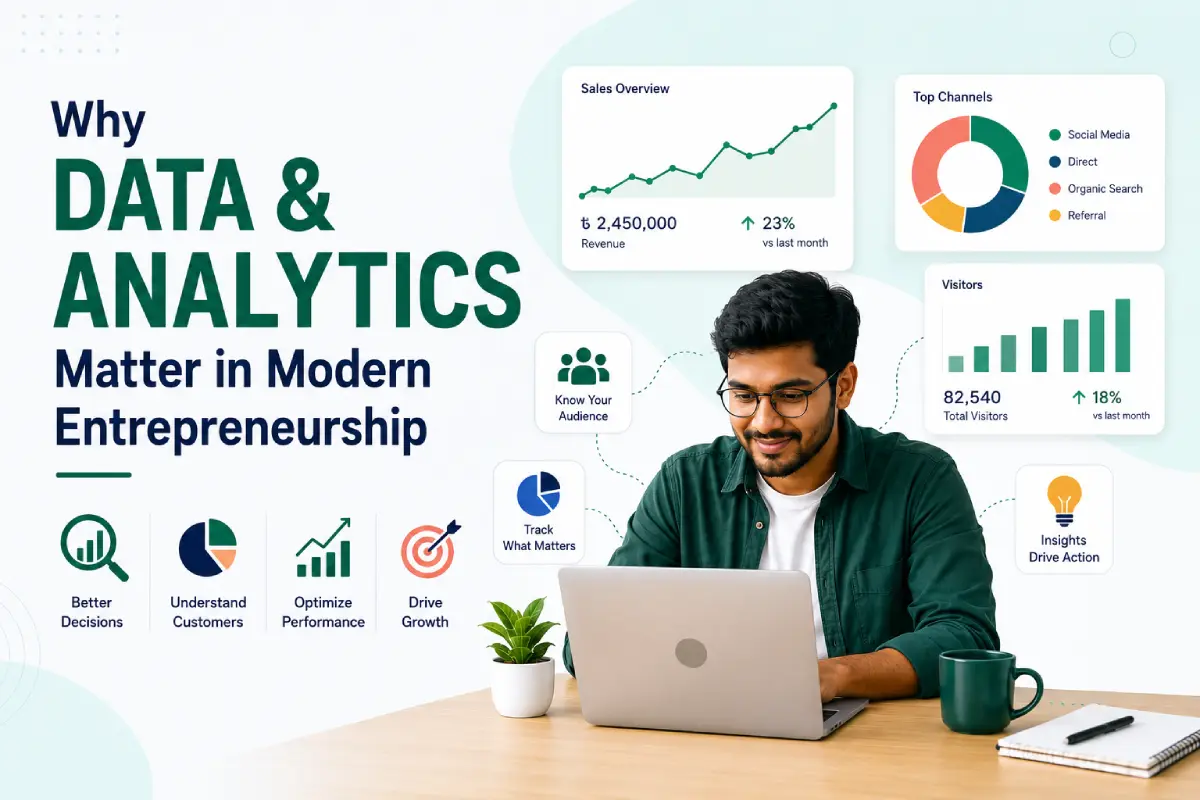
Why Data and Analytics Matter in Modern Entrepreneurship
Quick Answer: Data and analytics help entrepreneurs replace guesswork with evidence. Instead of relying on instinct alone, you use real numbers — from sales figures to customer behaviour — to make decisions that are faster, cheaper, and far more likely to succeed. In 2026, it is not a competitive advantage; it is a baseline requirement.

Facebook Marketing for Bangladeshi SMEs: Strategy, Ads, and ROI
Quick Answer: Facebook marketing for Bangladeshi SMEs involves building an optimized Business Page, posting consistently for organic reach, and running targeted paid ads using Meta Ads Manager. With over 50 million Facebook users in Bangladesh and low ad costs compared to Western markets, SMEs can generate strong ROI even on modest budgets of BDT 5,000–20,000 per month.
Comments (0)
No comments yet. Be the first to share your thoughts!