Freelancing as an Export Business in Bangladesh: Platforms, Payments, and Taxes
Bangladesh Bank treats freelance income as a service export under Part K of its July 2026 export circular. Qualifying tech work can be tax-exempt through June 2027, but only as a registered business with a Trade Licence, TIN, and BIN. Banks may also deduct 10 percent at source on incoming service fees.
Key Takeaways
Bangladesh Bank's consolidated export circular of July 30, 2026 added Part K, a dedicated rulebook for freelancers and individual service exporters
The Section 21 tax exemption runs to June 30, 2027 and requires a registered business with a valid Trade Licence, TIN, and BIN, plus banking-channel transactions
Banks may deduct 10 percent tax at source under Section 124 on inbound service fees, which you must reconcile in your return to claim back
The remittance-style 2.5 percent bonus and the freelancer export cash incentive are two different schemes, and bKash confirms the first does not apply to Payoneer transfers
ICT-related service exporters can retain up to 50 percent of earnings in an ERQ account, other service exporters up to 30 percent
Most freelancers in Bangladesh treat foreign income as remittance, and assume remittance means tax-free.
That assumption is wrong in a specific and expensive way. Under the Income Tax Act 2023, if you live in Bangladesh and provide a service from here, the payment counts as income arising in Bangladesh regardless of where the client sits.
There are real exemptions available. They just have conditions attached that many freelancers never check until a tax officer asks.
This guide covers what Bangladesh Bank's 2026 framework actually says about getting paid, which tax provision applies to which kind of work, and where the two separate 2.5 percent schemes diverge. If freelancing still feels like a side income idea to you rather than something with its own rulebook, this is the point where that changes.
Picking Platforms Worth Building On
Upwork, Fiverr, Freelancer.com, and Toptal are all widely used by Bangladeshi freelancers, and all settle conveniently to Payoneer.
Platform choice matters less than service category. Income from these platforms is treated as business income, and whether it qualifies for exemption depends on whether the underlying work counts as a technology-based business under the tax law.
Training options exist locally. 10 Minute School runs a freelancing course taught by a top-rated Upwork freelancer, which is a faster start than learning the marketplaces alone.
Keep every contract, invoice, and payment confirmation. Bangladesh Bank's rules now accept platform statements and email records as valid evidence for freelance transactions, so this has regulatory value, not just bookkeeping value.
Getting Paid: What Each Channel Actually Does
Payoneer is one of the most widely used payout routes among Bangladeshi freelancers, mainly because it links directly to bKash.
That convenience has a documented limit. According to bKash's Payoneer service page, the 2.5 percent government incentive does not apply to Payoneer-to-bKash transfers, because that route is not treated as a remittance under the scheme.
Wise operates under restrictions here. Bangladeshi residents cannot open a Wise multi-currency account or receive USD account details, so Wise mainly works when a client abroad sends BDT into a bank account, bKash, or Nagad.
Several newer fintech apps promise dollar-holding for Bangladeshi freelancers. Check that any such service routes through a Bangladesh Bank-recognized arrangement before using it, because retaining export proceeds abroad outside permitted accounts is a contravention of the Foreign Exchange Regulation Act, 1947, not a grey area.
One documentation point worth knowing: no single certificate covers everything. An authorized dealer bank can issue a certificate against IT-related services, and a mobile financial service provider can request an electronic encashment certificate from its bank, but the circular states that certificate is intended for income tax purposes only. Ask your bank which document fits your specific transaction.
Registering: The Trade Licence Question, Answered
For foreign-exchange purposes, you do not need a company. Bangladesh Bank's framework explicitly covers freelancers and individual service exporters as individuals.
For tax purposes, the answer is different and more demanding. To qualify for the technology-business exemption, the activity must be conducted as a registered business with a valid Trade Licence, TIN, and BIN, supported by proper banking transactions.
That means a freelancer with only a TIN who assumes their income is automatically exempt is exposed. The business registration process is worth completing before your income grows large enough to draw attention.
A dedicated business bank account helps here too, since the banking-channel condition is easier to demonstrate when business income is not mixed with personal spending.
Tax Rules: Which Provision Applies to You
Two different Sixth Schedule provisions get confused constantly, so it helps to separate them.
Section 17 exempts foreign income brought home through banking channels, but only when the taxpayer earned it by physically working abroad. Working remotely from Dhaka for a foreign client does not qualify, because you are still a resident earning from a Bangladesh-based activity.
Section 21 is the one that matters for freelancers. It exempts income from specified technology-based activities, including software development, AI solutions, data analytics, IT freelancing, and BPO services such as call centres and digital archiving, for the period from July 1, 2024 to June 30, 2027.
Salary from a foreign employer is treated differently again. Regular remote employment income is employment income and is taxable, not covered by the technology-business exemption.
If your work falls outside the qualifying categories, ordinary progressive slabs apply once you cross the year's tax-free threshold. That treatment differs from the startup tax rules applying to registered companies, since you file as an individual.
The 10 Percent TDS Most Freelancers Miss
This provision catches people who think exemption means nothing is deducted.
Under Section 124, tax at source of 10 percent is deductible when a resident taxpayer's service fee or revenue share arrives from abroad against services performed within Bangladesh. Banks frequently deduct this when crediting the remittance.
Section 150 requires that deducted tax be reconciled against your total liability in your return. The problem is practical: many freelancers never collect the bank's deduction certificate, so they cannot claim credit for tax they already paid.
Ask your bank for the TDS certificate every time it deducts. Without it, money that should reduce your bill just disappears.
Eligible business expenses, including internet, software subscriptions, and equipment, may be deductible against non-exempt income, subject to the documentation and depreciation rules that apply to any small business.
Two Different 2.5 Percent Schemes
The first is the wage-earner remittance incentive, a government top-up on money sent home through licensed channels. It applies to remittances, which is precisely why bKash excludes Payoneer settlements from it.
The second is a genuine export cash incentive. For FY2026-27, Bangladesh Bank set a 2.5 percent rate for freelancers exporting software and ITES services, against 6 percent for software, hardware, and ITES exporters generally, across 43 eligible sectors.
Being a service exporter does not automatically make you an incentive recipient. Claims go through your authorized dealer bank and are subject to the audit requirements that apply to export incentive applications, including external audit by approved firms.
Ask your bank what its current claim process and documentation set looks like before assuming any payment qualifies.
Bangladesh Context: Retention and Thresholds in 2026
Bangladesh Bank's consolidated export circular of July 30, 2026 repealed and replaced the previous instructions, consolidating everything including the new freelancer provisions into one document valid for a year.
Inward remittances against service exports up to $20,000 can be credited without a Form-C declaration, with the bank satisfying itself from the payment message instead. Repatriation through internationally recognized Online Payment Gateway Service Providers is capped at $10,000 per transaction under that particular facility.
Authorized dealers can issue dual-currency Freelancer Cards to individual developers and freelancers who hold relevant training or course certificates. Inward receipts on those cards above $20,000 require a Form-C (ICT) declaration.
On retention, reporting on the July 2026 changes indicates ICT freelancers may retain 50 percent of export earnings in an Exporters' Retention Quota account, with other service exporters allowed 30 percent. The rest converts to taka.
Practical Steps to Set Up Your Freelance Export Business
Get a TIN first, then decide whether you need the Trade Licence and BIN. If you intend to rely on the Section 21 exemption, you need all three.
Collect the TDS certificate from your bank every time it deducts at source. This single habit recovers money that most freelancers silently forfeit.
Choose your payment route with both incentive schemes in mind rather than convenience alone. Payoneer-to-bKash is fast but sits outside the remittance incentive and does not enrol you in the export cash incentive either.
Store contracts, invoices, and platform statements by month. The circular now treats this electronic evidence as legitimate documentation, which works in your favour when organised.
File your return every year regardless of whether tax is owed, and reconcile any deducted tax against your liability rather than ignoring it.
If freelancing is a long-term plan rather than a stopgap, it is worth reading on where the future of freelancing in Bangladesh is heading, since both the tax provision and the incentive rates carry expiry dates.
Frequently Asked Questions
Is freelance income from abroad automatically tax-free in Bangladesh?
Do freelancers need a trade license to claim the tax exemption?
Why did my bank deduct tax from my freelance payment?
Is the Payoneer-to-bKash incentive the same as the freelancer export incentive?
What documents prove freelance income came from abroad?
Can freelancers hold their earnings in US dollars?
Knowing Which Rule Applies Is the Whole Job
The difference between a freelancer who keeps their earnings and one who quietly loses a slice of them is rarely effort. It is knowing that Section 17 and Section 21 are not the same, that TDS gets deducted whether or not you claim it back, and that two unrelated schemes both happen to be set at 2.5 percent.
A TIN, an honest assessment of whether your work fits the qualifying categories, the registrations the exemption actually requires, and a bank that tells you what it deducts and what it can certify, together cover most of the gap.
Whether you need professional tax help depends on your income and how cleanly your services fit the exemption list. This guide summarises the position as of the July 2026 circular and the current Sixth Schedule provisions. Confirm the details with your authorized dealer bank and a qualified tax professional before relying on any specific exemption, deduction, or incentive.

Specializing in SaaS product marketing, SEO strategy, Content marketing, TikTok advertising, PPC, and digital growth.
View Full Profile & ContributionsRelated Articles
The Freelancing Future of Bangladesh in 2026
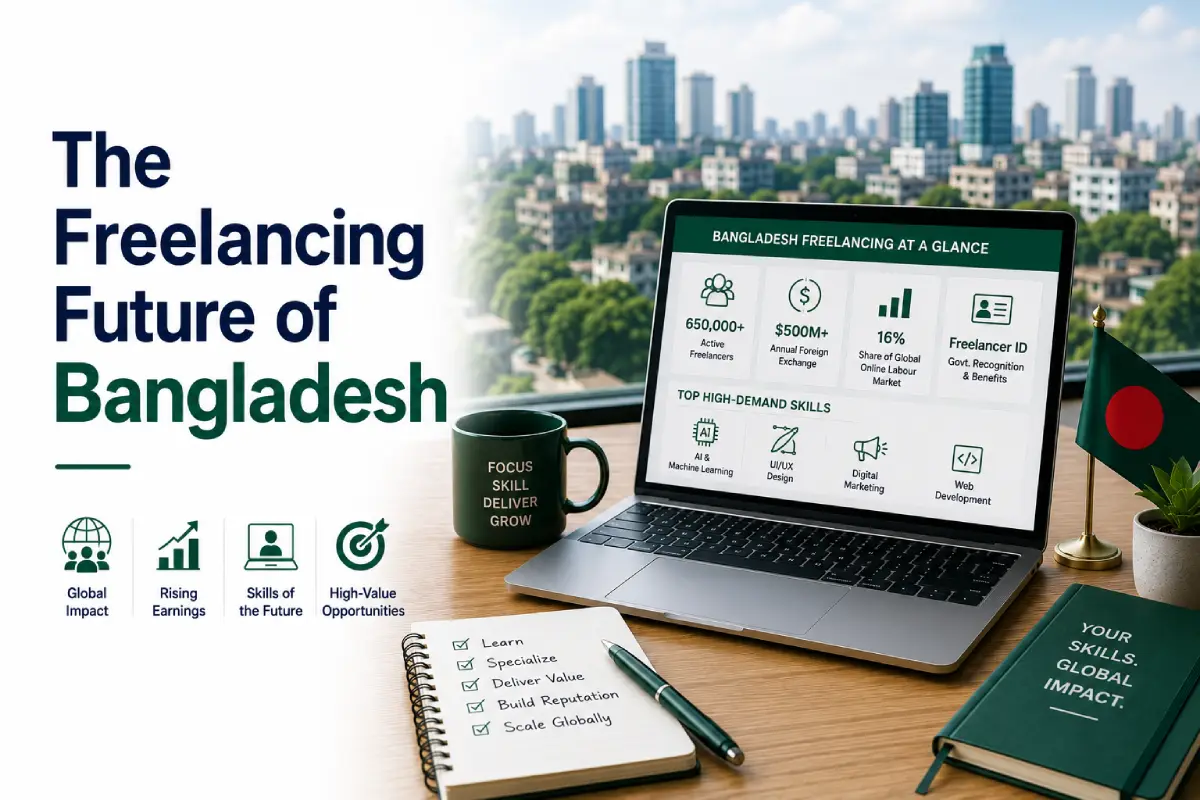
Quick Answer: Bangladesh is the world's second-largest freelancing workforce, with over 650,000 active freelancers earning more than $500 million in annual foreign exchange. In 2026, the sector is shifting from low-cost task work toward high-value specializations in AI, UI/UX, and digital marketing, with new government infrastructure making the ecosystem more formal and bankable than ever before.

Affiliate Marketing in Bangladesh: How to Earn and How to Set Up a Program
Affiliate marketing lets Bangladeshi creators, bloggers, and site owners earn commissions by promoting products from platforms like Daraz, Amazon Associates, and global networks such as ClickBank or Digistore24. Businesses can launch their own program with tracking software, clear commission terms, and payout channels that follow Bangladesh Bank's remittance rules for service exporters.
Comments (0)
No comments yet. Be the first to share your thoughts!