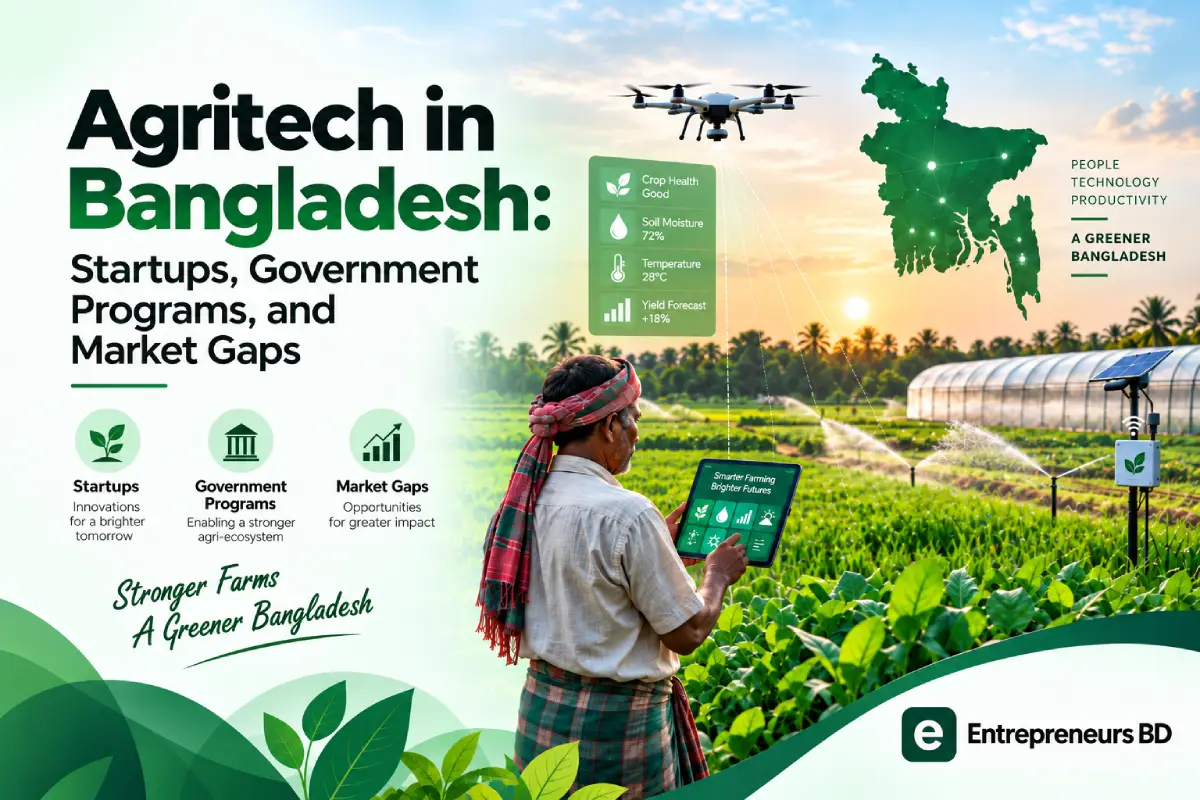
Agritech in Bangladesh: Startups, Government Programs, and Market Gaps
Bangladesh's agritech startups tackle farm financing, input access, and produce distribution for a country where agriculture still employs 45 percent of the workforce. iFarmer leads by reported farmer reach; Agroshift, Fashol, WeGro, Krishi Shwapno, and Agronochain fill other niches. Government backing runs through Bangladesh Bank's credit policy and Startup Bangladesh Limited. The clearest documented opportunity is produce processing, where more than 75 percent of output still leaves the field untouched.
Key Takeaways
iFarmer's own site reports over 310,000 farmers across 42 districts, up from about 63,000 at its 2022 raise, spread across four products: Folon, KriShop, iharvst, and Sofol
Agroshift raised $1.8 million in what Techloy called Bangladesh's largest-ever pre-seed round; Fashol's founder told AgFunderNews the company had raised about $2.1 million total as of mid-2024
Startup Bangladesh Limited has deployed roughly Tk 109 crore across 36 startups as of June 2026, distinct from its larger planned fund structure
Bangladesh's disclosed startup investment fell 95 percent year-on-year in H1 2026, to $6.0 million from $120 million
BIDA says more than 75 percent of Bangladesh's agricultural production remains unprocessed, the clearest documented value-chain opportunity for a new entrant
Bangladesh feeds over 170 million people. Agriculture still employs 45.4 percent of its workforce.
For most of the country's farming history, a smallholder with a good harvest had no easy way to get fair financing or a fair price. The money often went to middlemen instead.
A small group of startups has spent the last several years trying to close that gap with technology. iFarmer connects farmers to financing and buyers. Agroshift and Fashol move produce directly to businesses. Krishi Shwapno and Agronochain are building the data layer underneath all of it.
This guide covers what these companies document about themselves, what government programs are putting real money behind the sector, and where the gaps remain open for the next entrant.
Top Agritech Startups In Bangladesh
Startup | Problem it targets | Model | What's documented |
|---|---|---|---|
Farm financing, input access, market linkage | Agri-fintech, now full-stack | 310,000+ farmers across 42 districts | |
Project-based farm investment | Investor-to-farmer financing | Current scale not publicly documented | |
Agroshift | Fragmented produce supply chains | B2B marketplace with collection centers | $1.8M pre-seed, reported as Bangladesh's largest at the time |
Fashol | Retailer access to fresh produce | Wholesale marketplace for retailers | ~$2.1M raised to date, per the founder's account to AgFunderNews |
Krishi Shwapno | Farmer data and commodity trading | Data and trading platform | Selected for IFAD's Innovatech 2.0 |
Agronochain | Agricultural traceability | Data and traceability platform | Selected for IFAD's Innovatech 2.0 |
iFarmer's own current About page states it was founded in 2018. It describes "a growing network of over 310,000 farmers across 42 districts."
Two third-party trackers give different years. CB Insights lists 2017, and Visa's 2024 accelerator announcement lists 2019. The company's own current statement is the clearest source, so this guide uses 2018.
iFarmer runs four products: Folon for direct farmer support, KriShop for inputs, iharvst for output and export, and Sofol. That "iharvst" name is a product line, not evidence of a company-wide rebrand.
Its funding history includes a $2.1 million equity pre-Series A in 2022 (IDLC Venture Capital Fund, Millville Opportunities, Startup Bangladesh Limited). Nexus for Development's Pioneer Facility added a $500,000 working-capital loan in April 2025. Symbiotics provided $1.5 million in debt financing in April 2026.
iFarmer also won Visa's 2024 Accelerator Program. It used the program to pilot a cashless Farmer Card with United Commercial Bank. That pilot distributed 17 cards at launch against a stated first-phase target of 150.
WeGro works a comparable niche: investors funding specific crop and livestock projects. No recent primary source gives its current farmer count or transaction volume.
Agroshift and Fashol tackle the other end of the chain, getting produce from farmers to buyers at a fair price. Agroshift's $1.8 million pre-seed round in 2022 was co-led by Shorooq Partners and Anchorless Bangladesh. Techloy reported it as the largest pre-seed round any Bangladeshi startup had raised at the time.
Fashol's funding is documented in more detail than most peers here. Its founder told AgFunderNews the company had raised roughly $2.1 million as of mid-2024, including a $1 million round from Orbit Startups and South Asia Tech Partners, with a further $3 million round in progress at that time ($1.2 million closed). Fashol runs a wholesale model selling directly to retailers.
Krishi Shwapno and Agronochain represent a newer category: farm data and traceability. Both were selected for IFAD's Innovatech 2.0 in October 2025. That international program pairs technical support and mentorship with an equity-free $90,000 grant per startup.
Where The Government Money Actually Goes
Three funding numbers get mentioned together often enough that they're worth separating clearly.
Figure | What it is | Status |
|---|---|---|
Tk 109 crore | Capital Startup Bangladesh Limited has actually deployed | Already invested, across 36 startups, as of June 2026 |
Tk 400 crore + Tk 300 crore | Fund of Funds and Co-Investment Fund structure | Vehicles being built out, not a running total |
Tk 1,000 crore | Government's stated future target for the overall structure | Planned, not yet deployed |
Startup Bangladesh's Tk 109 crore portfolio spans ride-sharing, edtech, fintech, logistics, healthtech, and e-commerce, including companies like Pathao, Chaldal, and 10 Minute School. It isn't an agritech-dedicated fund, but its mandate allows equity and equity-linked investment in qualifying startups, and it co-invested in iFarmer's 2022 round.
The broader environment is tougher than that single figure suggests. Bangladesh's disclosed startup investment fell 95 percent year-on-year in H1 2026. It dropped to $6.0 million across six deals from $120 million across 14 deals, per LightCastle Partners.
Software and financial services led that period. Agritech doesn't appear in the report's top categories, which just means no clear agritech-specific figure exists for that window.
Two government programs put money and infrastructure directly behind agriculture rather than startups specifically. Bangladesh Bank's FY2026-27 policy set a Tk 60,000 crore agricultural credit target, up 53.85 percent from Tk 39,000 crore, per BSS.
Banks must now direct 4 percent of total lending to agriculture. Fisheries and livestock loans up to Tk 5 lakh no longer require collateral.
Separately, the Department of Agricultural Extension runs a toll-free advisory line, 16123, listed on Bangladesh's national government portal. It reaches farmers without smartphones or data access.
Challenges Agritech Startups Still Face
A few structural obstacles show up across most of the companies covered here, based on how they describe their own work.
Fragmented, small farms. Most Bangladeshi holdings are smallholder plots, which raises the cost of collecting produce, verifying data, and building creditworthiness one farmer at a time.
Rural connectivity gaps. DAE's phone-based advisory line exists largely because a meaningful share of farmers can't reliably use a smartphone app, which limits how far app-based platforms alone can reach.
Financing risk that's hard to price. Investors have to weigh flood and cyclone exposure and price volatility on top of ordinary startup risk.
Thin downstream infrastructure. BIDA's own data shows most agricultural output leaves the field unprocessed, and cold chain investment is flagged as a priority without much documented private activity behind it yet.
A shrinking funding pool. The 95 percent year-on-year drop in disclosed startup investment for H1 2026 makes it harder for any agritech company, new or established, to raise a fresh round right now.
Where The Clearest Opportunity Sits
BIDA's own sector data is the most concrete evidence available. More than 75 percent of Bangladesh's agricultural production remains unprocessed.
That's a documented value-chain opportunity, not proof that no startup anywhere is working on it. But among the companies covered in this guide, processing and cold storage show far less activity than financing does.
Output market linkage (Agroshift, Fashol) and farm data (Krishi Shwapno, Agronochain) are already being worked. Transaction volumes for the former aren't public.
Rural insurance is the one category where this research found no meaningful activity or penetration data at all.
For a founder or investor comparing options: financing is the most crowded lane among established players. An incumbent like iFarmer already has 310,000+ farmers and four live product lines.
Processing, cold storage, and insurance are less contested. BIDA's own priority list backs that up, even without a dollar figure attached.
Frequently Asked Questions
What are the biggest agritech startups in Bangladesh?
How can technology actually help Bangladeshi farmers?
How much funding does Bangladesh's agritech sector receive?
Does the Bangladesh government fund agritech startups directly?
What's the biggest challenge facing Bangladeshi agritech startups?
What's the most clearly documented opportunity for a new entrant?
The Bottom Line
Bangladesh's agritech sector is moving from early experimentation toward real infrastructure. iFarmer's growth from 63,000 to 310,000+ farmers shows a financing-led model can scale here.
Agroshift and Fashol show output-side marketplaces can raise real money too.
The next winners will likely be whoever tackles what's still thin: processing, cold storage, and the data layer connecting farms to buyers and banks. BIDA's own numbers point there directly, even if the exact size of the prize isn't yet quantified.
Government policy is moving in the same general direction: more agricultural credit, a growing but still modest startup investment fund. But agricultural credit and startup capital remain two different pools of money.
Whether the second one grows more agritech-specific from here depends on how the broader funding contraction plays out over the rest of 2026.

Specializing in SaaS product marketing, SEO strategy, Content marketing, TikTok advertising, PPC, and digital growth.
View Full Profile & ContributionsRelated Articles
Why Most Bangladeshi Startups Fail — and What You Can Do Differently
Quick Answer: Most Bangladeshi startups fail because of poor market validation, weak financial planning, and founder-market mismatch, not lack of ideas or effort. The founders who survive focus on solving real problems, build lean, and learn from their market before scaling.

Customer Acquisition Strategies That Work for Bangladesh Startups
Quick Answer: The most effective customer acquisition strategies for Bangladesh startups combine low-cost digital channels (Facebook, WhatsApp Business, SEO), mobile financial service integration for frictionless payment, referral-driven growth, and hyperlocal targeting. Startups that blend paid acquisition with retention-focused tactics see the lowest long-term cost per customer.

Business Model Canvas Explained with Bangladesh Startup Examples
Quick Answer: The Business Model Canvas (BMC) is a one-page strategic framework with 9 building blocks: Customer Segments, Value Propositions, Channels, Customer Relationships, Revenue Streams, Key Resources, Key Activities, Key Partnerships, and Cost Structure. It helps founders map, test, and communicate their entire business model before writing a single page of a business plan.
Comments (0)
No comments yet. Be the first to share your thoughts!