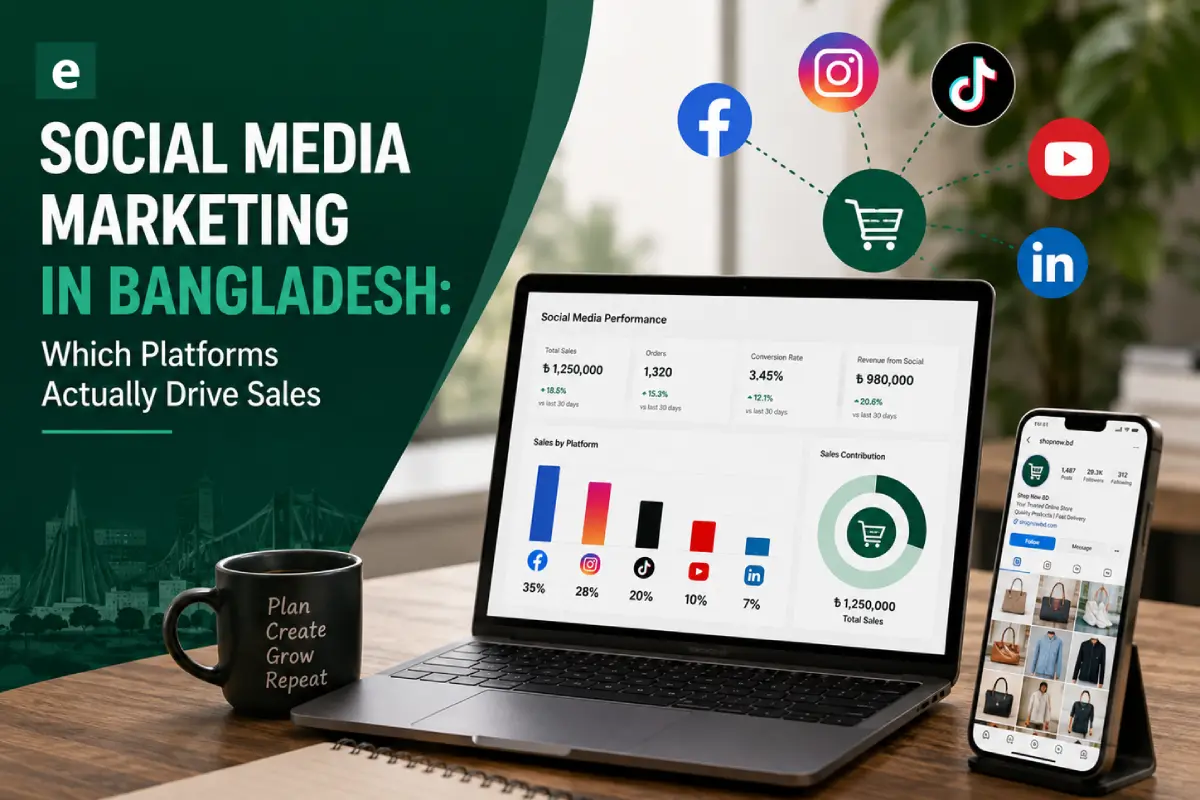
Social Media Marketing in Bangladesh: Which Platforms Actually Drive Sales
Quick Answer: In Bangladesh, Facebook remains the dominant platform for direct sales, particularly through Facebook Pages, Groups, and Messenger commerce. YouTube drives strong purchase intent through product reviews and tutorials. TikTok is rapidly gaining ground with younger buyers. The right platform depends on your product type, target audience, and budget, not on what is globally popular.
Key Takeaways
Facebook is still the primary sales channel for most Bangladeshi SMEs and F-commerce businesses
YouTube influences purchase decisions more than any other platform, especially for high-value products
TikTok Shop is growing fast among Gen Z buyers in urban Bangladesh
Instagram works best for lifestyle, fashion, and food brands targeting affluent urban consumers
LinkedIn drives B2B leads but requires patience and consistent positioning
Mobile-first content consistently outperforms desktop-optimized formats across all platforms in Bangladesh
Social media marketing in Bangladesh is not one-size-fits-all. The platforms that drive real revenue for a Dhaka-based garments reseller look nothing like what works for a SaaS founder or a Chittagong-based food brand.
Yet most advice on this topic either recycles global statistics that have no local relevance or simply tells you to "be on all platforms." Neither approach helps you make decisions with a limited budget and a real business to run.
Bangladesh has one of the most mobile-heavy internet populations in South Asia. According to BTRC's telecom statistics, mobile internet subscriptions crossed 120 million in 2026, meaning most of your potential customers are accessing social media through a smartphone on a data plan. That single fact should shape every platform decision you make.
This article breaks down the platforms actually driving sales for Bangladeshi businesses right now, what each is genuinely useful for, and where founders commonly waste money chasing the wrong audience.
Why Platform Choice Matters More in Bangladesh Than You Think
In most developed markets, businesses can afford to test multiple platforms simultaneously. Ad budgets are large, and data comes back quickly enough to course-correct.
In Bangladesh, most SMEs and early-stage startups operate on tight marketing budgets. Spreading resources across five platforms does not diversify your risk; it dilutes your impact. You get weak results everywhere instead of strong results somewhere.
The other variable is audience behavior. Bangladeshi consumers do not move through social media the same way as audiences in Europe or North America.
Buying decisions happen faster on Messenger. Group-based commerce still drives significant volume. Trust is built through voice notes and live videos, not polished brand copy.
Understanding these dynamics is not optional. It is the difference between campaigns that convert and campaigns that burn budget.
Facebook: Still the Sales Engine for Most Businesses
Facebook is not dying in Bangladesh. For the majority of businesses targeting consumers aged 18 to 45, it remains the highest-ROI platform available.
The Meta Bangladesh market data consistently shows Bangladesh among the top countries by Facebook user count in South Asia. More importantly, Bangladeshi users are highly active buyers on the platform, not passive scrollers.
What actually drives sales on Facebook in the Bangladeshi context:
F-Commerce through Pages and Groups: Thousands of businesses operate entirely through Facebook Pages with no separate website. Buyers message directly, negotiate prices, and complete purchases through bKash or Nagad confirmations sent over Messenger. This model works because it removes friction and builds personal trust.
Facebook Groups for community commerce: Niche groups around fashion, electronics, homemade food, handicrafts, and baby products generate consistent, warm leads. Sellers who actively contribute to these communities before selling outperform those who only post product photos.
Messenger as a sales channel: Automated Messenger flows using chatbot tools have become a significant conversion tool for Bangladeshi businesses. A well-designed Messenger sequence can handle objections, share pricing, and close sales with minimal human involvement.
Paid ads for scaling: Facebook's targeting options allow Bangladeshi businesses to reach very specific demographics, including by location down to upazila level, age group, interest, and device type. For businesses with a proven organic offer, paid amplification on Facebook delivers measurable returns.
Where Facebook underperforms is B2B, very high-ticket products, and audiences under 20. Those segments have drifted elsewhere.
YouTube: The Platform That Builds Purchase Confidence
YouTube does not give you the immediate transaction volume that Facebook does. What it does is shape buying decisions before buyers ever reach your sales page or Messenger inbox.
In Bangladesh, YouTube is the go-to research platform before major purchases. Before buying a smartphone, an air conditioner, a skincare product, or an online course, a significant share of Bangladeshi consumers watch at least one YouTube review. A product appearing in a trusted review channel carries more social proof than dozens of Facebook comments.
For businesses, this creates two clear opportunities:
Organic content for search-driven buyers: Tutorial videos, product demonstrations, and honest comparisons rank in both YouTube and Google search. A well-optimized Bengali-language video for a product category can drive steady, free traffic for months.
Influencer and creator partnerships: Bangladesh has a robust mid-tier creator ecosystem on YouTube. Creators with 50,000 to 500,000 subscribers often charge reasonable rates compared to their reach and conversion power. The key is selecting creators whose audience profile closely matches your customer.
YouTube ads, particularly skippable in-stream ads, can build brand awareness cost-effectively. However, for direct sales conversion, YouTube works better as a supporting channel than a primary one.
TikTok: Fast Growth, Real Sales, Specific Audience
TikTok's user base in Bangladesh has grown sharply since 2023, particularly among users aged 16 to 30 in urban and semi-urban areas. Crucially, TikTok has moved beyond entertainment into commerce behavior in ways that surprised many local marketers.
TikTok Shop, where it operates, allows product discovery and purchase within the same session. Even outside formal TikTok Shop infrastructure, creators regularly drive buyers directly to Messenger or WhatsApp for transactions after a short product video.
What TikTok is effective for in Bangladesh:
Fashion items, accessories, beauty products, and novelty goods
Food businesses, particularly street food and home-cooked meal delivery
Affordable products where impulse buying applies
Brands targeting Gen Z specifically
What TikTok is not suited for: complex B2B services, premium high-consideration products, and businesses that cannot produce consistent short video content. TikTok's algorithm rewards frequency and novelty. Businesses that post once a week rarely build meaningful traction.
The production barrier is lower than most founders assume. Authentic, slightly rough videos consistently outperform overproduced content on the platform. A founder showing their product being made in real-time often converts better than a polished ad.
Instagram: Niche-Effective, Not Mass Market
Instagram in Bangladesh is real but concentrated. It performs well for specific categories: fashion brands, food businesses, lifestyle products, beauty, travel, and anything where visual aesthetics drive purchase desire.
The audience skews toward urban, higher-income consumers, particularly in Dhaka. If your product targets this segment, Instagram is worth investing in seriously. If your audience is broader or more price-sensitive, Instagram will likely underperform relative to Facebook or TikTok.
Instagram Reels have improved organic reach significantly. Businesses that commit to consistent Reels production, particularly with trend-aware hooks, can build followings without heavy ad spend.
Instagram also works well for brand-building alongside sales on other platforms. A buyer who finds you on Facebook may check your Instagram to assess brand legitimacy before completing a purchase. An inactive or inconsistent Instagram page can quietly cost you conversions even when you are not directly selling there.
LinkedIn: B2B Lead Generation, Not Instant Sales
LinkedIn's user base in Bangladesh is smaller but growing, and the quality of engagement for B2B purposes is meaningfully higher than other platforms. If your business sells to other businesses, particularly in sectors like technology, consulting, education, HR, or finance, LinkedIn deserves serious attention.
The World Bank's Digital Bangladesh initiatives have contributed to rapid growth in the formal corporate sector, creating a larger professional audience on LinkedIn than existed five years ago.
What works on LinkedIn in Bangladesh:
Thought leadership content: Long-form posts discussing business challenges, industry problems, and real-world lessons from running a company build credibility over time. This is the core currency of LinkedIn.
Direct outreach for high-value services: Founders selling consulting, software, training, or recruitment services can use LinkedIn's messaging effectively when the outreach is genuinely relevant and non-generic.
Company Page credibility: Bangladeshi B2B buyers often check a company's LinkedIn page before signing contracts. A well-maintained page with regular content signals operational legitimacy.
LinkedIn requires patience. Do not expect rapid lead flow in the first month. Businesses that commit to six months of consistent posting typically see meaningful inbound movement by month four or five.
How to Choose the Right Platform for Your Business
The decision framework is simpler than most people make it.
Answer these three questions:
Who is your buyer?
-Age, location, income level, and device preference matter more than demographics in the abstract.
What is your product?
-Impulse-buy products belong on TikTok and Facebook. Research-heavy purchases need YouTube. B2B services need LinkedIn. Aspirational lifestyle products need Instagram.
What can you actually sustain?
-The best platform is one you can show up on consistently. A business posting twice a week on one platform outperforms a business posting occasionally across five.
For most Bangladeshi SMEs starting out, the answer is Facebook first, YouTube second for content-driven industries. Add TikTok when you have video production capacity. Add LinkedIn when you are targeting businesses. Consider Instagram when your brand identity justifies a visual-first presence.
According to the Bangladesh Investment Development Authority's SME sector data, small and medium enterprises make up the backbone of Bangladesh's private sector. Most of these businesses have marketing budgets that demand precision, not experimentation.
Frequently Asked Questions
Which social media platform has the most users in Bangladesh?
Is F-commerce still profitable in Bangladesh in 2026?
How much does Facebook advertising cost in Bangladesh?
Is TikTok a reliable sales channel for Bangladeshi businesses?
Does YouTube work for small businesses in Bangladesh?
Should a Bangladeshi startup use LinkedIn for marketing?
Match Platform to Purpose, Then Execute Consistently
Social media marketing in Bangladesh rewards specificity and consistency more than it rewards scale. The businesses generating real revenue from social media are not the ones managing six platforms. They are the ones who picked the right two or three platforms for their exact buyer profile and showed up consistently enough to build trust.
Facebook remains the non-negotiable starting point for consumer-facing businesses. YouTube builds the purchase confidence that Facebook alone cannot manufacture. TikTok is the channel to watch and test if your product has visual appeal and your buyer is young. LinkedIn is for B2B, and Instagram is for brands where aesthetics are a selling point.
The most common mistake Bangladeshi founders make is choosing platforms based on personal preference or global trend articles rather than their actual customers' behavior. Your 45-year-old garments buyer in Narayanganj is not on Instagram. Your 24-year-old cosmetics buyer in Dhaka is not only on Facebook.
Spend one week mapping where your existing buyers actually come from. That data will tell you more than any benchmark study. Build from what already works, and add new platforms only when you have the capacity to do it well.

Specializing in SaaS product marketing, SEO strategy, Content marketing, TikTok advertising, PPC, and digital growth.
View Full Profile & ContributionsRelated Articles
Google Ads for Bangladesh Businesses: Setup, Budget, and Bidding Guide
Quick Answer: Running Google Ads for Bangladeshi businesses means setting up BDT billing and conversion tracking first, sizing a daily budget against your own profit margins (most SMEs start at 500 to 2,000 taka), and starting with manual CPC or Maximize Clicks before switching to Smart Bidding once you have steady conversion data.
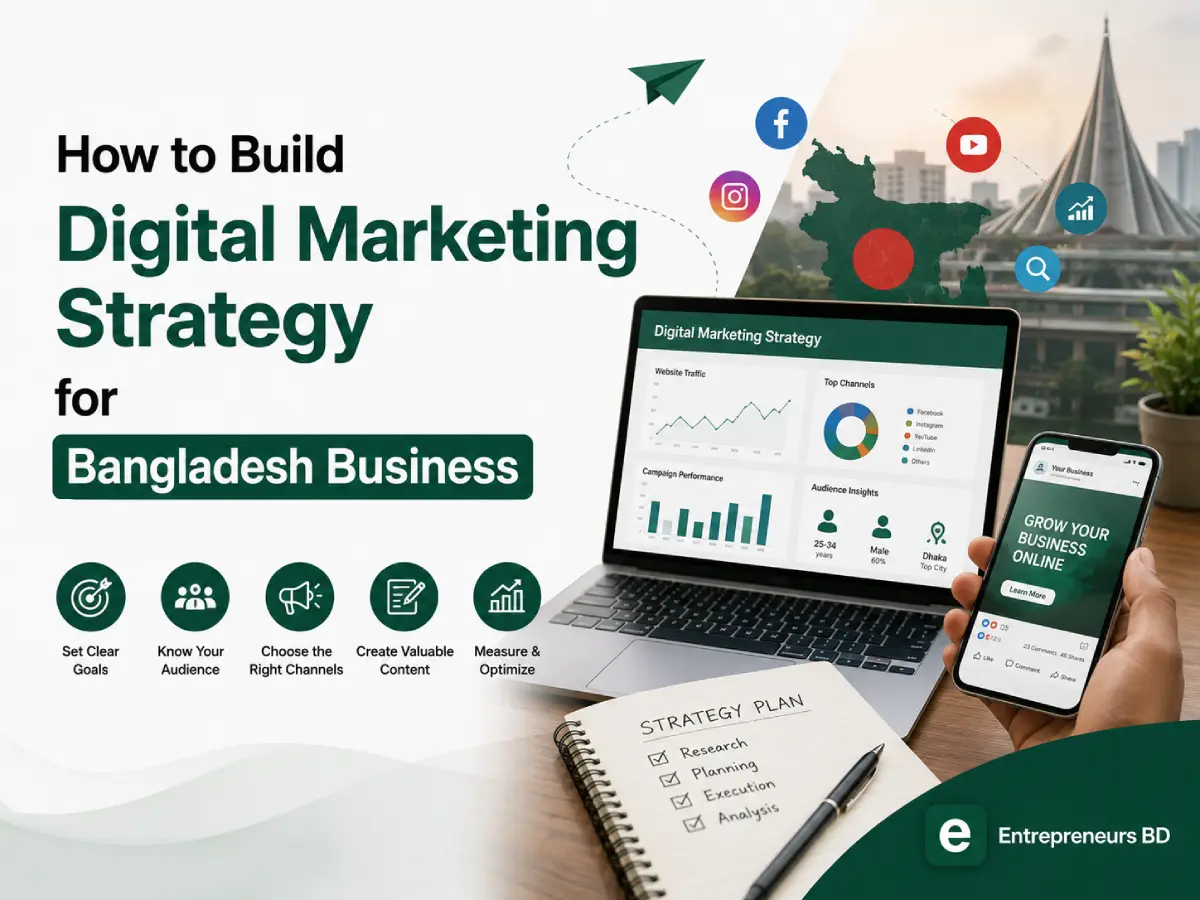
How to Build a Digital Marketing Strategy for a Bangladesh Business
A digital marketing strategy for a Bangladeshi business is a structured plan that defines your target audience, chooses the right channels (Facebook, Google, email, SEO), sets measurable goals, and allocates budget to reach customers online. Given Bangladesh's mobile-first internet culture and active Facebook user base, your strategy must prioritize mobile optimization and platform-specific content.
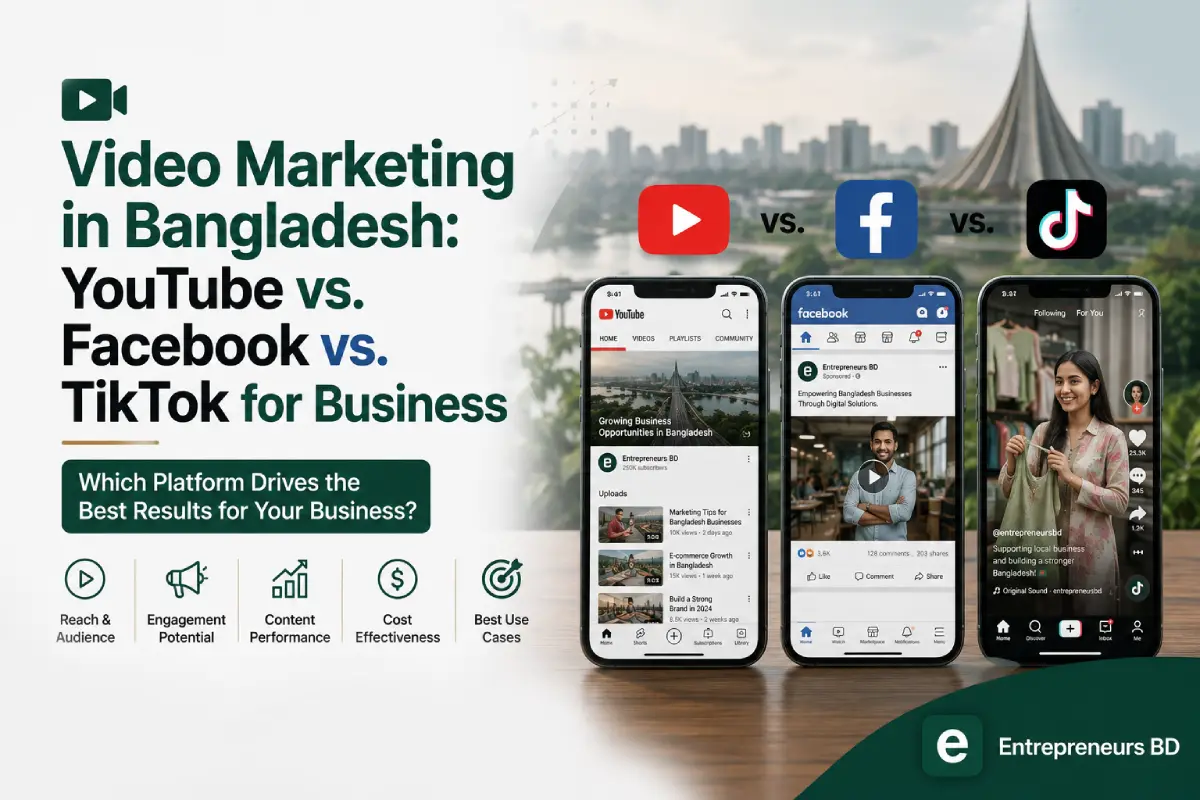
Video Marketing in Bangladesh: YouTube vs. Facebook vs. TikTok for Business
Facebook still reaches the most Bangladeshi users, making it the safest default for general brand and sales videos. YouTube builds long-term trust through search and detailed product demos. TikTok delivers the fastest reach among under-35 audiences for the lowest production cost. Most businesses need a mix, not just one channel.
Comments (0)
No comments yet. Be the first to share your thoughts!