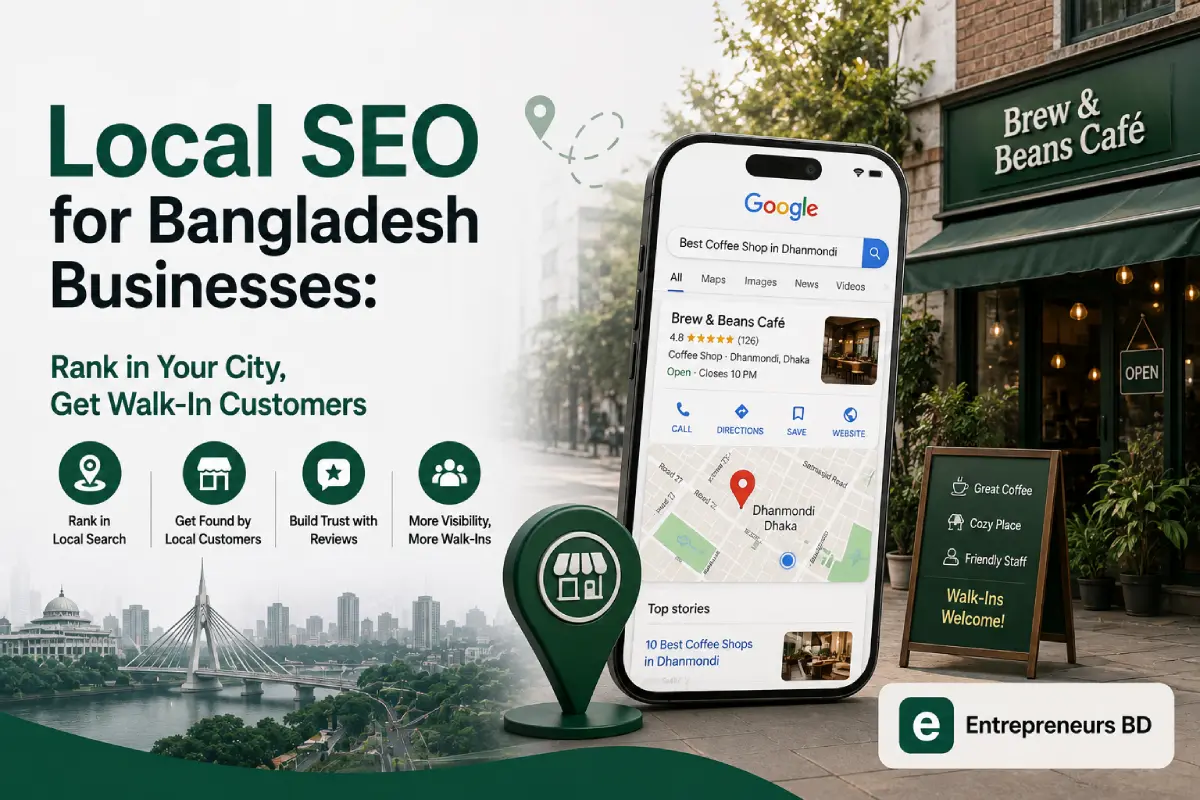
Local SEO for Bangladesh Businesses: Rank in Your City, Get Walk-In Customers
Local SEO for Bangladesh businesses means optimizing your Google Business Profile, keeping your name, address, and phone number consistent everywhere online, and using city and neighborhood keywords on your website. Together, these signals tell Google your business belongs in local search results, which drives more calls, direction requests, and walk-in customers from people searching nearby.
Quick Answer: Local SEO for Bangladesh businesses means optimizing your Google Business Profile, keeping your name, address, and phone number consistent everywhere online, and using city and neighborhood keywords on your website. Together these signals tell Google your business belongs in local search results, which drives more calls, direction requests, and walk-in customers from people searching nearby.
Key Takeaways
Local SEO targets people searching for a business near a specific location, not general keywords.
A fully optimized Google Business Profile is the highest-leverage step for most Bangladeshi shops and service businesses.
NAP consistency (name, address, phone) across your website, directories, and social pages directly affects local ranking.
Neighborhood and city-level keywords convert better than generic keywords.
Reviews, local photos, and community activity build the trust signals Google rewards in map results.
A customer in Dhanmondi searching for "AC servicing near me" almost never scrolls past the first three map results. Local SEO for Bangladesh businesses is what decides whether your shop appears in those three spots or gets buried on page two, invisible to someone standing two streets away.
For a bakery in Uttara, a tutoring center in Chattogram, or a hardware store in Sylhet, ranking locally is often worth more than ranking nationally, since the person searching is already close enough to walk in.
This guide covers the practical steps that move a Bangladeshi business into local search results: setting up a Google Business Profile correctly, fixing NAP consistency, choosing local keywords, and building the community signals that turn searches into customers at the door.
Why Local Search Decides Who Walks Through Your Door
Local search results work differently from regular results. Google shows a map with three business listings above the standard blue links, and most people never scroll past it.
Someone typing "mobile repair shop near me" is usually ready to visit within the hour, not researching for later. That is where most "near me" searches convert.
Bangladesh's internet base now sits well above 130 million subscribers, most of it mobile, according to BTRC's internet subscriber data. That pushes Google to prioritize the closest, most relevant match over a generic national result.
For a shop owner, visibility is no longer just a nice sign outside. It comes down to whether Google trusts your business enough to place it in that first map result, and that trust is built through the signals covered below.
Claim and Optimize Your Google Business Profile
Your Google Business Profile is the foundation of local SEO. It is the listing that shows up when someone searches your business name or a relevant local keyword.
Start by claiming or creating a profile through Google's official setup process. Verification usually happens by phone, email, or a card mailed to your address.
Once verified, fill in every field, since business category, hours, phone number, and website all feed into how Google matches your listing to a search.
Set your service area carefully if you deliver to customers rather than running a single storefront. Google's documentation on editing profile fields walks through configuring this correctly.
Add real photos of your storefront, products, and team, since profiles with recent, genuine photos consistently outrank ones with stock images. Post small updates regularly, even something as simple as new stock, so the profile signals to Google that the business is genuinely operating.
NAP Consistency: The Foundation Local Rankings Are Built On
NAP stands for name, address, and phone number. Google cross-checks this across every source it finds: your website, your Facebook page, directories, and your Business Profile.
A mismatch is treated as a trust problem, not a small typo. One outdated phone number on a single directory can quietly suppress your ranking everywhere else.
Write your name, address, and phone number exactly as they appear on your registered trade license, then use that exact format everywhere. This matters most for entrepreneurs still finalizing their business registration in Bangladesh, since the registered address becomes the reference point for every listing after it.
Dhaka North City Corporation's trade license portal lists the documents and steps for registering or renewing a license, and that same address should carry through to your website footer, your profile, and every directory.
Audit your listings for outdated addresses or numbers at least twice a year, since one stale entry can undo the consistency Google is otherwise seeing.
Local Keywords That Match How Bangladeshi Customers Actually Search
Generic keywords like "furniture shop" rarely help, because the competition is national. What ranks is the combination of service plus neighborhood or city, the way a real customer types when nearby: "furniture shop in Mirpur," "best biryani in Bashundhara," "AC repair Chattogram."
Use these combinations naturally in your page titles, headings, and opening paragraph. A dedicated page for each service area or branch performs better than one generic page covering an entire city.
For businesses still building a broader SEO foundation, a companion piece on general SEO fundamentals for Bangladeshi business websites covers the technical basics behind this work.
Avoid repeating the same city name in every sentence. One clear mention per section is enough for Google, and it reads better to a customer too.
Bangladesh Context: Directories, Community Groups, and Local Trust
Beyond Google, Bangladeshi customers still lean on community recommendations. Local Facebook groups for a residential society or market association often work as an informal directory before a customer opens Google at all.
Staying active in these groups, and linking back to your Business Profile from your Facebook business page, reinforces the same trust signals Google already tracks.
Encourage satisfied customers to leave a Google review right after a purchase or visit. A steady stream of recent reviews mentioning the product or service by name outperforms a large batch of old, generic ones, and responding to every review, including negative ones, shows Google and customers alike that the business is engaged.
Local directories tied to a city corporation or chamber of commerce also carry real weight, since they are harder to fake than a generic listing site.
A Practical 30 Day Local SEO Action Plan
Week one: claim or verify your Google Business Profile, fill in every field, and upload at least ten real photos.
Week two: audit every directory and social listing for NAP consistency, correcting any mismatched address or number you find.
Week three: rewrite your homepage and key service pages with natural city and neighborhood keywords, guided by the same digital marketing basics that keep messaging consistent across channels.
Week four: request reviews from your last twenty customers, respond to any existing reviews, and post your first weekly update.
Repeat this cycle every month. Local SEO rewards consistency far more than one big push.
Frequently Asked Questions
What is local SEO and how is it different from regular SEO?
How long does it take to rank in local search results in Bangladesh?
Do I need a website to rank in local search?
How many Google reviews does a business need to rank well?
Can a home-based or delivery-only business use Google Business Profile?
What is the fastest way to lose local ranking in Bangladesh?
Turning Local Search Into Customers Who Actually Walk In
Local SEO is one of the few marketing efforts a small Bangladeshi business can control almost entirely without spending on ads. A complete Google Business Profile, consistent NAP details, and a handful of genuine local keywords do most of the work.
None of it requires a large team or a big budget, only consistency: updating the profile, checking directories, and asking for reviews, month after month.
The businesses that show up in the top three map results in their city did not get there by accident. They built the same trust signals covered in this guide, one update at a time.
Start with whichever step is currently weakest, whether that is an unclaimed profile, a mismatched address, or a website with no local keywords, and fix it this week.

Specializing in SaaS product marketing, SEO strategy, Content marketing, TikTok advertising, PPC, and digital growth.
View Full Profile & ContributionsRelated Articles
Google Ads for Bangladesh Businesses: Setup, Budget, and Bidding Guide
Quick Answer: Running Google Ads for Bangladeshi businesses means setting up BDT billing and conversion tracking first, sizing a daily budget against your own profit margins (most SMEs start at 500 to 2,000 taka), and starting with manual CPC or Maximize Clicks before switching to Smart Bidding once you have steady conversion data.
How to Build a Digital Marketing Strategy for a Bangladesh Business
A digital marketing strategy for a Bangladeshi business is a structured plan that defines your target audience, chooses the right channels (Facebook, Google, email, SEO), sets measurable goals, and allocates budget to reach customers online. Given Bangladesh's mobile-first internet culture and active Facebook user base, your strategy must prioritize mobile optimization and platform-specific content.
Video Marketing in Bangladesh: YouTube vs. Facebook vs. TikTok for Business
Facebook still reaches the most Bangladeshi users, making it the safest default for general brand and sales videos. YouTube builds long-term trust through search and detailed product demos. TikTok delivers the fastest reach among under-35 audiences for the lowest production cost. Most businesses need a mix, not just one channel.
Comments (0)
No comments yet. Be the first to share your thoughts!